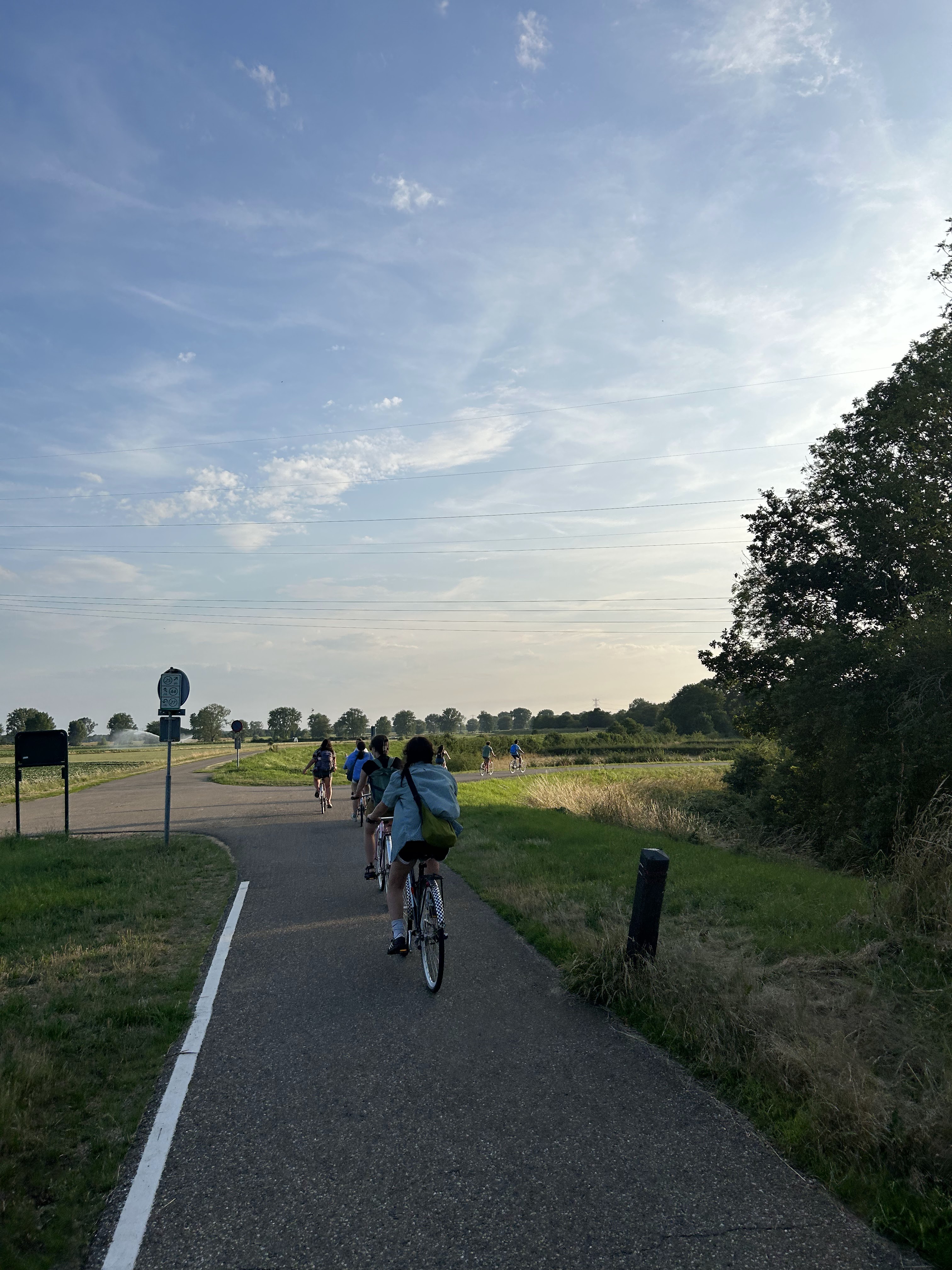
Saturday, July 15, 2023

Top 5 Insights Thus Far

Here are my top insights after experiencing the bike infrastructure here for almost a month:

Traffic Calming and Infrastructure that Drives Behavior

A speed bump for bromfietsen and snorfietsen

The traffic calming here is very interesting to witness. As a foreigner who doesn't speak the language or understand every sign, it is something that makes to roads accessible for all users. There are continuous sidewalks, extended curbs at intersections, narrower roads, and speed bumps (even for snorfietsen and bromfietsen!) that force everyone to follow the rules. This seems like a no-brainer when you experience it, but it has opened my mind to designing streets in order for people to behave how you want them to, instead of using signs. Doing so can also open up more public space and green space to be used by the surrounding community. This would work in the US, even if we are different from these countries, because it would allow for our neighborhood streets to be calmer and quieter, which is what people want for their kids, as can already be seen with the "children play here" signs in use. Traffic calming infrastructure would work better than those signs because it's not something people can ignore.

Designing Cities for Kids

Kids being independent

In each of the cities we've been to, you can see young children alone walking/biking around and being independent. It is clear that the cities were designed so that they would feel safe enough to explore them and get around, and so their parents wouldn't worry either. There are always recreational activities for them to do and creative playgrounds that show the kids they are welcome here. It's important for us to remember to design cities so that the most vulnerable population (kids) will be safe. If we do this, everyone feels safer on the city streets. This would work in the US because people want their kids to feel safe, and ultimately kids want to be independent and will go out alone whether their parents like it or not, so creating space for kids in cities is important for the kids themselves as well for the less vulnerable people with added safety measures.

Street Redesign

A street that has been redesigned

Another thing that has surprised me is how many of the streets here that have nice traffic calming and bike infrastructure once looked exactly like our streets in US cities: super wide with no bike infrastructure and maybe a broken sidewalk. The people who make the argument that America could never be this country must not understand that the infrastructure here was very similar before street redesign processes took place, and that we can change our streets back home to be safer for everyone as well. None of these countries got it right on the first try, and neither did we, but that doesn't mean we can't change.

The Little Things

A trash can on a cycle track

The small infrastructure amenities that make bike commuting easier in each of these countries are super important to the amount of people that cycle here. It's about making the bike the easiest option to get somewhere, or at least easier than the car, and having things like foot rests, trash cans, and stair ramps help people to make the "lazy" choice of getting on their bike to go to work or the grocery store. This would work in the US because people there are lazy too, and would enjoy a foot rest at a stop, or a trash can so they don't have to hold their trash until they reach one or litter. It also helps to make cyclists feel more welcome and more safe, as if they have a place there, which helps us to design our streets for people instead of cars.

Hardware and Software

A fietsstraat in Houten

Building up the hardware (infrastructure) is just as important as building the software, or the culture of respecting people on bikes and ensuring that they have a safe trip wherever they're going. Approaching it from both sides is how the Dutch have their successful fietsstraaten and rural infrastructure, and a lot of it is because the people in cars cycle places too, so they understand what it's like to be on a bike with a car behind you. Building a culture around bikes can happen with the help of infrastructure, education, and tradition. The software aspect is one of the things I hear most about why US cities "could never be cycling cities;" however, we can develop that culture with education beginning in young children. If those who drive also cycle and know how to be aware and respectful, the streets would be safer for everyone, and who doesn't want safe streets?

Wednesday, July 12, 2023

Nijmegen Reflection

Though I would've liked to spend more time in Nijmegen and I enjoyed it more than I thought I would, I was only able to spend 2 days there. But, as always, I have some thoughts about the infrastructure and activities I did while I was there.

Bike Infrastructure

A tunnel with a bike path going through it

The bike infrastructure in Nijmegen is a lot more connected than I thought it would be for such a small city, especially navigating our way into the city center while staying somewhat on the outskirts. Most of the bike infrastructure here is either a fietsstraat (a red road where bikes have priority and cars are guests), protected lanes (smooth surface or cobblestones, one-way or two way), or bridges/tunnels. The bridges and tunnels here are really interesting because they provide a safe connection to many places with fully separated bike infrastructure, either going through a tunnel under an important road or train pathway, or a bridge over bodies of water.

A busy cycle intersection

Another thing that surprised me was the amount of people using all of this infrastructure. For some reason I thought that because it's smaller than Amsterdam there would be a lot more people in cars, but the cycle tracks were always full of people, even in the middle of a week day. There were people using the infrastructure outside of the city and within the city, which was super cool to see (if you build it they will come!).

A photo from our first tour on a bridge

During our time in Nijmegen, we were able to go on two tours of the city and surrounding area from planners with two different perspectives, and we were able to see a lot of the infrastructure that makes this city great, as well as some of the failures.

The bike stair ramp in use

The good news from the tours is that Nijmegen has some of the little infrastructure amenities that Amsterdam was lacking in places, like bike trash cans. Another super cool thing was the bike stair ramps that have bristles on the way down so that your heavy bike doesn't force you to run down the stairs, and power on the way up so that you don't have the push your bike up the stairs. 

The ghost bike from the Nijmegen accident

The bad news from the tours were some of the infrastructure and policy failures of Nijmegen. One of the more sad failures was a ghost bike at one intersection where someone was struck and killed by a truck driver. In that intersection, there is not a separated or protected bike lane for cyclists going straight and cars turning right, so they share a lane. In this instance, a truck driver was turning right, and they struck the woman going straight, causing her death. This, and lack of change that is happening because of it, is a reminder that even the Netherlands isn't a perfect utopia, and that every person living anywhere deserves to have infrastructure safe enough that they can get where they're going without risking their life.

Before (top) and after (bottom) the street redesign

Nijmegen has some similar failures to the US, specifically in designing roads to be car-centric. However, many of these roads have now been redesigned to make them safer for the people on bikes and for people walking, instead of more convenient for the cars at the expense of the people. One example was a wide road with black asphalt and narrow sidewalks being turned into a red fietsstraat, narrowed with brick strips on the side (that are small enough so that cyclists don't think they're a bike lane) with continuous and wider sidewalks, permeable street parking, and many speed bumps that have small sections of flat road on either side for cyclists to easily pass through. The street before the redesign looked a lot like a typical American neighborhood street, so this is super valuable in showing us what we can do to make our streets safer back home and a reminder that we can fix what we've done wrong.

Biking to Germany

Our group at the Germany-Netherlands border

Though we took some wrong turns, the bike infrastructure was so connected that we were able to ride all the way to the Germany-Netherlands border (10 miles there, 10 miles back), despite taking a wrong turn and accidentally going on a gravel walking path. 

Riding next to train tracks

This was a really cool experience, and we were riding along old train tracks for most of the way. It was super interesting to see the culture and language shift as we interacted and said good morning to everyone we passed, going from Dutch to German.

A sign showing the connection to the next cycle path

On our way, even as we got closer to Kranenburg, Germany, there was clearly a focus on keeping connected infrastructure for cyclists. When there was construction that caused the cycle path to end, there was a clear sign with directions on the safest way to get to the next section of the separated cycle path.

Biking outside of Nijmegen

Our last activity in Nijmegen was riding to a barbeque at a house in the Dutch suburbs (which happened to be the same day as the Germany ride, so we ended up riding 45 miles that day).

A roundabout with a sign pointing towards Nijmegen

The infrastructure on the way there and back was connected, straight, and protected in places with high traffic levels. There were some places with lower quality bike paths that hadn't been maintained as well, but the majority of the journey was smooth and easy to follow, with signs pointing towards Nijmegen and the fastest route possible having bike infrastructure on it.

An example of a suburban cycle path connecting with a street

The suburban infrastructure was still very connected as well; it was somewhere between the classic Dutch rural design with one lane for cars and two lanes for bikes on either side, some protected/separated lanes, and a fietsstraat, but it definitely works for this level of traffic and there are many people who were using it. The grocery stores and other markets were still very close, unlike in American suburbs, so people use their bikes to run errands, and kids use them to do recreational activities and go to friends' houses. Many people still have cars, but they use the infrastructure there when they can.

The lake in the suburbs

Another thing that was interesting about the Dutch suburbs was the amount of recreational activities to do. One main summer activity in this neighborhood was swimming, because it is near a lake, and it always surprises me how well the space is used here so that people feel like they are allowed to use it. The lake had bike access, bathrooms, and tree cover for people to sit under. While swimming, we asked some locals if they commuted places on bikes and they said they didn't bike a lot, and mostly their parents drove them places (they weren't 18 yet, so they couldn't drive). They did say they biked when they could for short distances, and they biked to the lake to swim, so that's better than getting to most American lakes.

Our group riding back to Nijmegen after swimming in the suburbs

Overall, Nijmegen surprised me with its infrastructure and the use of it by so many people, and I could definitely see it as a goal for US cities at some point when it comes to street redesign. I really wish I could've spent more time there to explore more of the city and see some more infrastructure!

Sunday, July 9, 2023

Biking in Amsterdam vs. Copenhagen

After a stressful travel day and the biggest summer storm in Amsterdam history, I wasn't liking Amsterdam too much and I didn't "get" the cycling and infrastructure here compared to how naturally it came to some other people. But, the other day it finally clicked and I had a great day exploring with purpose and understanding things here, so now I feel like I can reflect and compare Amsterdam to Copenhagen.

But first, Clog Bakfiets!

Before I go into the comparison of the systems, I just wanted to show off that I got to ride a clog bakfiets!!

Me riding with Emma (top) and Sydney (bottom) on the clog bakfiets

Observations about the Dutch System

Alexanderplein, an intersection with no traffic lights or stop signs

My first observations about the Dutch system were about the flow of everything. One of our assignments was to obstruct traffic and in doing this I realized that people on bikes and on foot will just flow around you even if you step out in front of them. This is made possible by the low speed of travel and is pretty cool because nobody will get hurt if someone makes a mistake, so it makes the system welcoming to beginners. It also makes it so that they don't necessarily need stop signs or traffic lights at every intersection here because people can yield when needed and flow around each other.

A red painted cycle track

I also thought it was hard to read and get used to the system at first because you're not sure of where you're allowed or supposed to be, but once you figure out that you can be anywhere with red paint, it helps you feel a lot more comfortable. There are also many other people on bikes you can follow to  make sure you're doing the right thing, and as I mentioned above, if you make a mistake people will just flow around you.      

Cobblestones on a bike street

Another thing I noticed is the presence of cobblestones on cycle tracks in much of the city. Some places are smoother than others but I was surprised at how bumpy some of the cycle tracks were. My only guess on why this might be is because many of the bumpy areas were in the city center where there are many pedestrians, so it is to keep cyclists slow enough so that they can stop to let pedestrians cross the street.

A speed bump

Lastly, the thing I notice the most here is the usage of infrastructure to drive behavior. Instead of signage or lights, infrastructure is used to be sure that people follow the rules. For example, on our biking tour, we were told that whichever road has a speed bump coming into an unmarked (no stop signs, yield triangles, or lights) intersection is the road where people are supposed to yield to others, but if you didn't know that rule, you would still be fine because the bump would slow you down enough to yield, which would not have happened if there was just a sign telling you to yield. 

Comparisons between the systems in Amsterdam and Copenhagen

Woman stopped in the middle of a cycle street talking to us; people just went around her

The main difference between the systems is how strict the "rules" are. Copenhagen has rules about how to make a left turn, hand signals you have to use to stop, etc., but Amsterdam has more of a flow where people use body language to communicate what they're doing and their judgement to determine if it's okay to turn left when they want. You can still follow rules in Amsterdam if you want, and use hand signals to signal stopping, but people won't get mad if you don't.

An intersection with no lights or stop signs

There are also a lot more lights and stops in Copenhagen than in Amsterdam, even in the cycle superhighways. Here, you are kept from going on autopilot as you ride because you have to think through intersections, so you will never find yourself forgetting how you got somewhere or if the light was green, like people do when they drive.

Intersection with no foot rests

One big difference between Amsterdam and Copenhagen is that Amsterdam has none of the little things that make biking a bit easier in Copenhagen, like foot rests, trash cans, and the yellow light before it turns green. While the system is generally better here in Amsterdam, I definitely notice the absence of those add-ons and I think Amsterdam would benefit from including them in their infrastructure, at least at the intersections where people will be waiting and could use them.

Cultural Differences

Someone sitting on the back of someone else's bike

Both places have a bike culture, but the bike culture in Amsterdam is a bit more developed and people here seem to trust cars more. The other main difference is that in Copenhagen the infrastructure use is very rule-oriented, and in Amsterdam it's chaos that flows. I think this probably has to do with how people are raised differently in the two cities, because the Amsterdam system might not make sense to people from Copenhagen and vice versa. This is important to remember in planning, that just because something is intuitive for you, doesn't mean it will work for everyone, and that's why community input is so important.

Convenience and Safety

I feel safer in Copenhagen because there is more separation and less shared roads which feel unsafe to me. Part of me knows that I shouldn't feel unsafe on them because the people driving there probably ride bikes too and will treat me like a human, but I am used to cars being aggressive at home, so it's still a bit scary. 

A car-free street

In terms of convenience, I think Amsterdam is better because the bike network connects you directly to destinations rather than just following the roads. It's also easier to stop and get off of the cycle tracks because there isn't a huge grade difference and you know people won't be angry.

My Preference

A graphic printed on a shared road that says "cars are guests"

Overall, I think I like Amsterdam better but I can understand why the Copenhagen system might make more sense to some people. Amsterdam is more chaotic and a bit overwhelming when you begin, but once you get the hang of it, you can appreciate how beautiful the flow is and have fun participating in it. Amsterdam does protection better with a lot more space between the cycle tracks and they do shared space better by making sure cars know that they are guests on the road, but Copenhagen is better with rule following and order. I think which system you like depends on your preference, but as someone who really appreciates rules and specific directions, I'm surprised that I love Amsterdam so much. 

Things to Transfer Back Home

A street designed so that it's one way for cars and two ways for bikes

The most important thing that I think would be really valuable back in the US is the design of infrastructure to drive behavior. I think a lot of Americans don't really obey signs, and it's hard to do so when the roads aren't designed in alignment with the signs; for example a really wide road that encourages speeding with a low speed limit that contradicts the design. The traffic calming and infrastructure design here that forces people to follow the rules is really interesting and allows for there to be intersections with no lights or stop signs. It is also legible for everyone; no matter what language they speak or how well they can read, the infrastructure will force them to slow down or yield without having to read and obey a sign.

An example of a ramp in Amsterdam

I also like the elevated lanes with a clear cut curb as protection and I think that would be very beneficial in America because it gives the cyclist a sense of protection  and it prevents the driver from easily driving onto the lane, which would allow people to ride more because they feel more safe. As long as there are ramps where people need them, whether asphalt or the more developed ramps here, the elevation is a good way to protect cyclists.

Someone riding in a shared "cars are guests" area between cars and bikes

All in all, I think the clear cut design of Copenhagen would be best to take back to America because it is easily readable for newcomers and we haven't developed a cycling culture as much as any of these cities have. In America, we wouldn't be able to simply put "cars are guests" on the road to have drivers be more respectful because we already have a culture of aggressive driving and car dominance. However, if we added Copenhagen-like infrastructure, I think it would make a lot more people feel safer cycling in the US. 

Random Thoughts

At this point in the study abroad it's hitting me hard how grateful I am to be here and to be surrounded by people that know what I'm talking about when I talk about bike infrastructure or planning because I don't have anyone like that back home. I'm very happy that I'm getting to participate in this wonderful experience with all of the other students and I'm having a lot of fun in Amsterdam. It's super cool to see that the "magic" of Dutch cycling is very real after only watching videos of it and reading about it for so long.

Scavenger Hunt Reflections

For most of our time in Amsterdam, we participated in an infrastructure scavenger hunt made by the Urban Cycling Institute to better understand how the cycling infrastructure here works. It included different "missions" to different places to learn about the history of the place and how the present cycling infrastructure is efficient.

Highlights of the Scavenger Hunt

Community Input

The most valuable parts of the scavenger hunt were when we were able to talk to residents of Amsterdam about how they're feeling about certain projects.

Central Station underground bike parking

First, we talked to people about the new underground bike parking garage at Central Station. All of them said that they like it and use it as often as possible, or whenever they're using public transit. Everyone is able to park their bike in the same place and easily know where it is, and it is inside so their bikes won't get wet while parked.

The new street design on Nieuwezijds Voorburgwal and the cafe on the right

Next, we talked to a business owner on Nieuwezijds Voorburgwal about the street redesign process there. That street used to be a road for cars with car parking on the sides, but its median was turned into a park with vegetation and tram tracks where cars can't get through, but people can walk across. We talked to the owner of a small cafe that was on this median and she said she was very happy with the changes that had been made. She said that the old road was very chaotic with cars, but now she's much happier because it's more quiet and she has more seating available for customers.

The Weesperstraat pilot project

Lastly, we talked to people about the controversial street pilot project on Weesperstraat, where the usually busy road is closed to cars from 6 am to 11 pm every day. Most of the people we talked to really loved it. One woman who lives nearby didn't have a car and she thought it was better for her pedestrian experience, and even her boyfriend, who has a car and has to take a longer, less direct route home, loves it and wants it to be permanent. Another person loved it because of the lower noise levels, and she thinks the city should be more car-free so that people can get around safely and easily. There were also construction workers that liked it because it gave them a job, but they also thought it was visually pleasing. The person who didn't like it as much was a delivery man, and he said it's hard for those who deliver things. He thinks that the concept is a good idea but he thinks they should've picked a street that was less important.

Other Interesting Highlights

The Alexanderplein intersection

One cool thing I got to observe was Alexanderplein, an intersection without any stop signs or street lights. There are yield triangles on the ground and crosswalks, but other than that, traffic flows and people crossing, cars, trams, and bikes figure out when to move forward. When I first saw this, it blew my mind and it was really interesting to watch the flow happen for a couple of minutes. I didn't see a single accident, and the closest it got was cars not yielding when they were supposed to, but not close enough to hit anyone.

The inside of Huis de Pinto

Another cool thing was that we were able to get a tour of Huis de Pinto. We walked in to try to find the hidden bike in the artwork, but a nice man gave us a tour because he thought it was cool that we were Americans. This was the house in the neighborhood where "urban renewal" (not like American urban renewal; in the Netherlands that is what they describe as the period where they retrofitted and preserved historic buildings) began. We got to walk through the house, see the courtyard, and look at old structures hanging on the walls. It was also very cool that the street it was on was the end of an old planned highway that was never built there, and that it is now a car-free street with only trams and bikes on it.

Reflection

A busy, car-free street

Debriefing at UvA after the scavenger hunt, the main thing that my group took away was that if you cater towards what people want in their community, you'll have a more efficient, lively, and activated use of space. Through our interviews with many of the residents, we realized that the places we went that the majority of people said they liked were the places where you could see lots of people, community plants around, etc. creating a lively and used space.

Our connection map

To wrap everything up, we made a map connecting the Environmental/Spatial and Political/Social aspects for the causes of a high level of cycling in the Netherlands and the consequences (positive and negative) of it. Our main conclusion from this was that community and bike infrastructure are very intertwined through community input into the planning process to provide access for all people including kids, lower-income people, and those with disabilities. This provides positive consequences to that community in the form of air quality effects, less car crashes, and better cardiovascular health. 

Rural Amsterdam Reflection

The Switch from Urban to Rural Infrastructure

Our first sights of the more rural infrastructure by a windmill

Going from the urban environment to a completely rural area in and outside of Amsterdam takes about 20 minutes, and there is generally no suburbia you go through to get there. As you move through, the infrastructure changes as well because there is less traffic on the roads. 

Rural infrastructure with two cars passing at once

Most of the rural infrastructure includes one shared lane for car traffic going both ways in the middle and two painted bike lanes on either side. There are also speed bumps and curbs to narrow the streets every so often. After riding on this for a while, it was clear that it worked because there was rarely two cars passing each other going different directions, and the traffic calming kept the cars going at such a low speed that if another car was passing in the opposite direction, there was enough time to figure out who would slow down to let the other car pass.

Why This Might Not Work in the US

Despite this infrastructure working well for the rural area here, I don't think this would necessarily be a wise idea for the US.

The Netherlands has a developed bike culture and most people in cars also ride bikes, so they treat cyclists like human beings and don't come close to killing them over road rage every day. This allows for the shared car lane and the unprotected cycle lanes to work in this instance. In the US, however, we do not have this developed culture, and while this might work in truly rural areas, I don't think it would be best for the more suburban areas where it issometimes proposed. The one way that this might work is with serious traffic calming measures, like narrowing the lanes and curbs, but it could be dangerous to do with the car dominant culture in America and most cyclists would appreciate more protection. 

Rural Activities and Bike Access

Swimming

The lake we swam at

Outside of Amsterdam, there is a lake where we went to swim, which was cool to see within the rural part of the country that wasn't near the coast and it included a restaurant and grassy areas to give the people living there something fun to do on a summer day.

Bike access (top) and bike parking (bottom) at the lake

The best thing about it was that the bike access was clearly prioritized, and we didn't even realize there was car access at all because the car parking was so out of the way. The cycle tracks were directly connected to the lake and there were large bike parking facilities right as you entered, which were both completely separated from the car parking facilities and the roads. It was pretty cool to see biking being prioritized at a swimming spot, because I've never seen that before at any beaches or lakes I've been to in the US, and it seems intuitive to want to bike back and dry off in the fresh air after going swimming.

Cheese and Clog Shop

The cheese part of the shop (top) and the clog part of the shop (bottom)

We went to a farm where cheese and clogs are made, and although it was a weird experience, it was cool to see how they prepare cheese and make clogs in the rural Netherlands. There was also a lot of farmland nearby, with bike infrastructure flowing through it, which was nice to bike through. The journey to the clog shop was very bike friendly and we were able to bike side-by-side for most of the way. The driveway to the clog shop was also very narrow and clearly meant for bikes to be arriving.

Overall, the rural experience was very cool and it is super interesting that we were able to make it to all of these locations in under an hour on our bikes.