Sunday, July 2, 2023

Malmo: Biking & Walking in a New Town

We're on our last day (day 3) in Malmo, Sweden, and although it's a short stop and we only had bikes for 1.5 days, I have some thoughts about the bike/pedestrian infrastructure and use here. 

How things work

Here in Malmo, most lanes are bidirectional, so one side of the street will have a wider cycle track, and the other side will be a side for the pedestrians. It's much less orderly than Copenhagen, and there's no specific ways to turn or to signal that you're stopping; people just figure it out with the yield signs. There is also no paint on the cycle tracks to indicate which side someone should stay on for which direction, and they are most often at the same level as the pedestrian walkways, just separated with material type and color.

Things that are done well

A bidirectional cycle path

My first impression of the bidirectional bike lanes was that they were a bad idea and when bike traffic got worse and they had to switch to unidirectional lanes, they wouldn't be able to do it. After giving it some thought and speaking with some other people, I've changed my mind and while I don't think they're ideal, I think they are a realistic first step that many cities in the US could benefit from, especially because using space for bike lanes is such an issue and having a bidirectional lane on one side will take away less parking. I also can understand how it might not be so bad when the switch from bidirectional to unidirectional lanes happens, because originally I thought that the bidirectional habits would be engrained in peoples brains and it would be complete chaos, but I realized that if people take these routes every day, they'll be able to figure it out and they'll notice the construction. Overall, I'm not a huge fan of the two-way lanes, but I know that in many US cities it's a more realistic step to getting safe bike infrastructure.

A continuous sidewalk and cycle track intersecting with a street

Another thing that is done really well in most places around the city is their traffic calming infrastructure. I've noticed that crosswalks are often at narrowed parts of roads, there are many traffic circles, and there are continuous sidewalks that stay at the same height where drivers have to go over cobblestone to get up to the sidewalk height. In the areas with this infrastructure, you can see the difference in the behaviors of drivers and how much better they treat cyclists and pedestrians in these places.

Bike parking with a car structure

They also seem to have really nice bike parking in most places here. Many people have told us that bike theft is a big issue, so its nice to see them starting to prioritize parking where you can lock your frame to the structure instead of just the wheel. It also seems like they generally have enough parking for everyone near busy places, like the mall and their pedestrian streets. You can also see cool parking structures around the city that have car structures attached to them, which serve the purpose of making sure people park their bikes on a certain side of the street, as well as showing how many bikes can fit into one car parking space, and the small amount of space that bikes take up, which can help people understand how they are more efficient and sustainable.

A pedestrian shopping street

Lastly, they seem to have a large amount of walkable areas that they have turned pedestrian only for such a small city, which is very exciting to see. They have many pedestrian streets that are either summer only or year-round, and it seems like they are so successful to the businesses that people are pushing to make most of them year-round. On all of these, even in the rain and wind, I have seen a lot of people walking through and in the businesses, so they are clearly working to bring economic gain as well as to bring the community closer together.

Things that are done poorly

One thing I don't like about the Malmo infrastructure is that, because there is only one side with a cycle track, there is usually only one side with good pedestrian infrastructure as well. This makes it hard to walk around because you're never sure if you're on the right side and you can't walk on whichever side you want to.

A busy intersection with traffic from many different ways

Another thing I don't like is that the intersections can get confusing with bidirectional lanes, especially during the switch to unidirectional lanes. There are some intersections that have bike traffic coming from five places that are all bidirectional, and it's hard to navigate that along with car and pedestrian traffic. It might have been okay when there were less people using the cycle tracks, but at the current traffic capacity, it doesn't work very well. Speaking of which, the bidirectional lanes cannot accommodate for a lot of traffic, so especially as bike traffic increases, it's hard to have so many people going two different ways in one cycle track, which pushes people into the pedestrian areas and makes things unsafe.

Being forced to ride on the sidewalk because the street felt too unsafe

I also don't like how many of the cycle tracks are disconnected and will end abruptly and you will be out on the road without a painted lane all of the sudden. Because the culture of respecting cyclists is not as developed here, it feels very unsafe to ride on the street and almost felt like we were back in America. Because we felt so unsafe, we began to ride on the sidewalk, but even then we got yelled at by pedestrians because we weren't supposed to be doing that. It feels like there are a lot of recreational paths here that are connected to some things, but not everything is connected, especially as you get out towards the edge of the city. In that sense, it is a bit like Columbia, MD, but I might go as far as saying that Columbia is more connected than here.

Malmo planners with photos of what the road looked like before the cycle tracks

Lastly, it seems like the funding is lacking here to do things they want with the streets. When listening to the city planners, it seems like they don't have much funding and have to do what they can instead of fully completing projects, and it seems like a lot of people still prioritize cars. This can also be seen from the behavior by people barely stopping for crosswalks and passing very closely when there is no bike infrastructure.

Malmo compared to Copenhagen

Coming straight from Copenhagen, Malmo was a bit of a downgrade and I am not the biggest fan of the city, but I also feel like I didn't have enough time or good weather to see all of it, so maybe I am making judgements based on a part of the city that is too small.

Copenhagen is a lot better in their bike infrastructure, but it is also a lot more developed and I do feel like Malmo's bidirectional lanes were a good start for introducing this infrastructure to the city without so much pushback, and they do have some good pedestrian infrastructure in their walkable areas.

A cycle path with no elevation change between the pedestrian walkway

One thing that is better in Malmo is that the cycle tracks are elevated from the road, but often times they are at the same level as the pedestrian sidewalks, with a material, color change, or signs to differentiate the two. I think this works a lot better than the asphalt in Copenhagen because it's easier to get off onto the sidewalk, and in places where a grade change is needed, they have one. This also ties in to how much more accessible Malmo is for people with disabilities than Copenhagen, especially people who use wheelchairs, or people who are blind and have a higher chance of tripping when stepping down. Malmo also uses a lot of smooth stone walkways rather than cobblestone, which still serves the purpose of a change in material and easy removal for maintenance, without the inaccessibility.

Overall, Malmo is okay, but not as good as Copenhagen, and I am interested to see how the switch towards unidirectional lanes in some areas will go moving forward.
Saturday, July 1, 2023

Copenhagen: Presentations & Tours

Our time in Copenhagen included a couple of super interesting presentations and tours that gave us some special insights into the city, specifically into their long and safe cycle ways, their architecture principles, and their waste management.

Cycle Superhighways

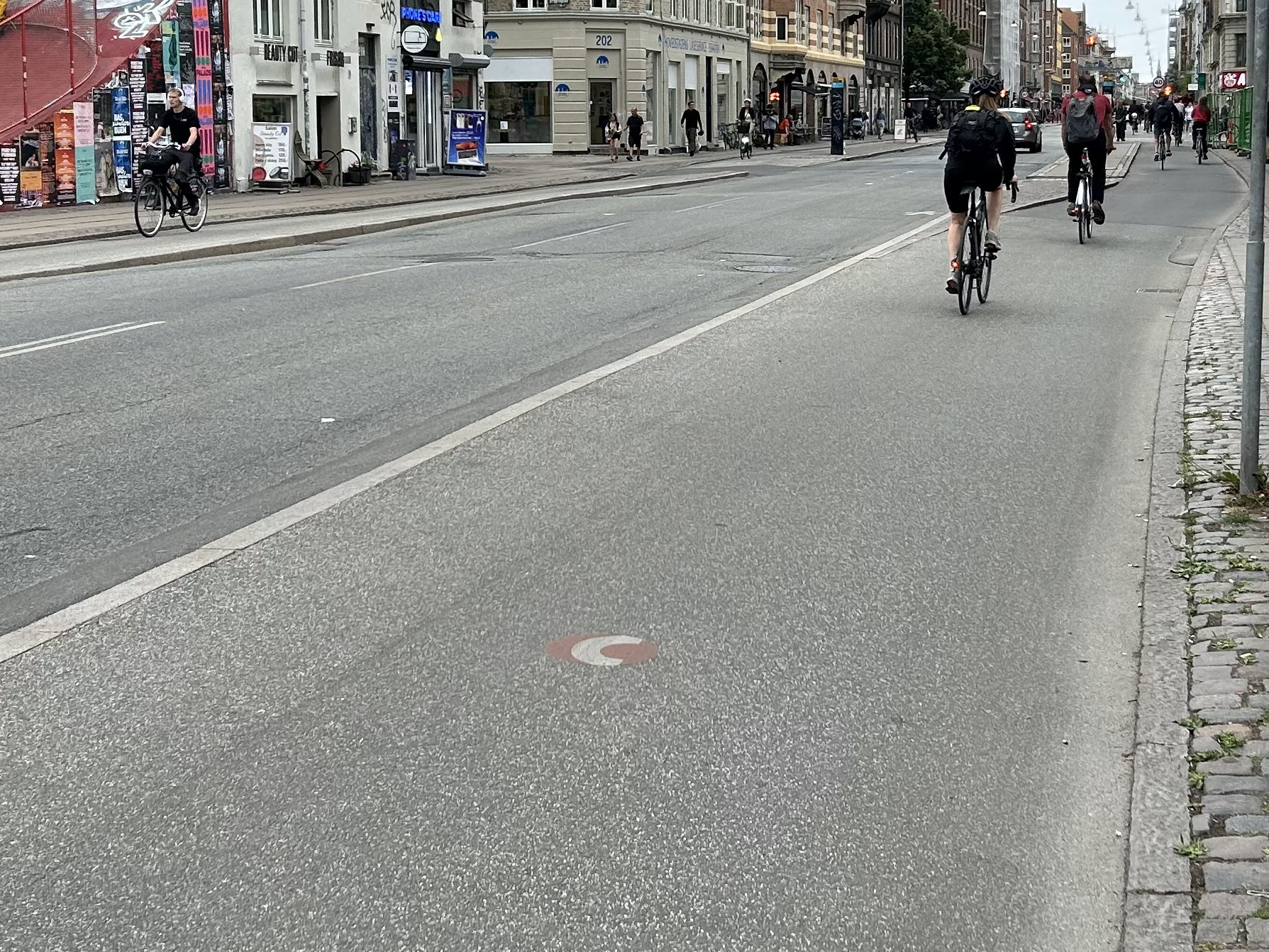
An orange circle with a C, marking the cycle track as part of a cycle superhighway

What are they?

Cycle superhighways are cycle routes in Copenhagen that are made for people to commute into and around the city. They are safe and connected routes where the commuter is the priority, and they are comparative to the S train network with an average of 13 km covered for each route. The goal is to make intuitive cycle routes so that the people that commute into the city can do so on their bikes. This is done by tackling the little things, such as adding foot rests at stoplights, and the bigger things, such as making sure there are a minimal amount of lights that people have to stop at on their way into the city.

How are they made?

Cycle superhighways are made by working together with municipalities and they are built with national funding. Routes are connected through existing infrastructure like puzzle pieces to create pathways, and standards are set for planning, building, way finding, and maintenance (it's cool to see maintenance included because one of the biggest problems with our bike lanes in MD are that they aren't maintained very well). 

In the presentation, it was stressed that communication is one of the most important factors in getting people to use their lanes. If they don't know its there, they won't be able to take advantage of it, so advertising that there is a safe and connected route into the city is super important to make it last and to be able to build more, especially when mayors are involved and residents feel like they're part of a story.

Effects

  • Average of a 36% increase in bike traffic with superhighways
  • 65% of Danes have a commute of 12 miles or less
  • Data showed a socio-economic return on investment: if you invest in cycle infrastructure you get it back, especially because of the health benefits
  • People have realized realized that it's possible to bike with the good infrastructure, signage, and communications

Gehl Architecture

A lot of the Gehl principles were very interesting to learn about and helped me take in the surrounding city in a new perspective. Here are some of the points that stuck with me:

  • Learn how people behave and the life they want, then shape the landscape around that
    • An example of this is desire paths, and creating real paths from dead grass that people have been walking over showing that they want a path there
  • Think of streets as both links to destinations and as places themselves
    • This helps people think of streets in a different way so that they can be made with care for all modes of transportation, places for people to stop or play, and aesthetically pleasing aspects of design
  • Active edges can improve people's experience on streets and help them perceive their travel time to be lower
    • Active edges are edges of buildings that are activated in some way through the architecture, showing that the space is used so they provide stimuli for people experiencing the environment
  • Choosing the right place for pilot projects is important
    • If you add a bike lane on a street that people don't use to get to work, people might not use it and you won't have the data that would show people that another bike lane could be helpful, but if you pick the right street that people use every day, the uptick in cyclists using the bike lane could be supported by that data
    • It's better to put a bike lane in where it takes you somewhere instead of just a random place
  • You don't have to fully remove car parking; you can change it to fix your streets
    • Removing street parking for a bike lane might be a mandatory concession on some streets, but on others, changing car parking to diagonal parking spots instead of parallel parking can help narrow the road and serve as traffic calming
    • People are more likely to be okay with street parking removals if it is replaced with something that enhances the community, like trees or a common area
  • In places where the bike commuter culture isn't already prevalent, it can take some time for bike lane usage to increase
    • Some places take 4 years to develop a bike culture, so it could take that long for the data to show from them using the bike lane
    • This relates to my transportation pre-assignment because the bike commuter culture is beginning to develop in Columbia, which could also explain the small amount of people using the Oakland Mills road protected bike lane

Copenhill

Me with the outside of Copenhill

Copenhill (or Amager Bakke) is a large ski hill, rock climbing facility, and rooftop bar, with a plant under it that turns Copenhagen's waste into energy for electricity and heat.

Waste-to-Energy

Our group 10 stories up inside the plant (top) & waste arriving to the plant (bottom)

Copenhagen collects household waste with electric trucks, and has large recycle stations for people to recycle and re-use. Commercial companies deliver their waste to the plant and have to pay based on how much waste they have. This waste is then used at Amager Bakke to produce heating through district heating and to produce electricity. The emissions from this plant are very low and far below many of the standards that have been set, and the gas coming out at the top is very clean, which is why it is able to be so close to the city and people are able to live right beside it.

Carbon Capture

A banner inside the plant that says "we capture CO2"

Amager Bakke has been a pilot project for carbon capture, and would be able to do carbon capture if they were able to get more money. The goal of the pilot project was to learn how to capture carbon and do it in an energy efficient way. They did this by using chemicals to capture it, then using the heat produced from capturing it for district heating. The plan when they are able to get more funding is to put the carbon into reservoirs where natural gas and oil have previously been taken out, use it to make ammonia fertilizers, or use it to make artificial fuels for ships/airplanes/trucks.

Rooftop

The ski lift (top) & the Copenhill rooftop (bottom)

The rooftop of Copenhill is an area where many people do grass skiing, rent out the bar area with games and tables for their company, or come up for a nice view of Copenhagen. The rooftop is completely unaffiliated with the waste-to-energy plant below (and we got kicked off of the roof during our tour of the plant, because even though we were approved to see that, we weren't allowed to be on the rooftop). This was a pretty cool use of space so that instead of just leaving the plant as is, the top and sides were converted into recreational areas.


- Lauren


Danish Architecture Center

After hearing about the Copenhagen in Common exhibit at the Danish Architecture Center, I was really excited to check it out for myself, so I rode the short ride over to the museum on some nice grade separated bike lanes to hopefully learn how those along with other infrastructure and architecture has developed in Denmark. 

So Danish Exhibit

Through I was mainly there for the Copenhagen in Common Exhibit, I really enjoyed this exhibit that provided me with a background on Danish architecture, and even some planning.

The Five Finger Plan

The thing I found most intriguing about this exhibit was the Five Finger Plan. The plan for the city's spread was that each of the fingers would correspond to a line on the S-train and the areas between the fingers would be to preserve nature, while the areas of the fingers would be for development. This plan is interesting because nature is a priority, but there is still area to develop, and it serves as an urban growth boundary to prevent sprawl.

The architecture history section of the So Danish exhibit

I also really enjoyed getting to learn more about architecture and see all of the models. I never knew that a Danish architect was responsible for creating the Sydney Opera House, and I learned a lot of other cool fun facts about architecture from this exhibit.

Common in Copenhagen Exhibit

This exhibit was really interesting and helped me to see the planning history of Copenhagen, especially their history of converting streets to be for people on bikes.

Environment

Signs from the environmental protest

There has been a debate and protests about one of the last uncultivated natural areas in Copenhagen, Amager Faelled, where some people want to develop the land for the growing population and some want to preserve the natural area. It has been used as a waste area from construction, but it has also been a habitat for some rare animal species. Despite that, Copenhagen does a lot and has done a lot to provide areas for animals within the city with big green spaces, whether that is rooftop gardens or greenways that prevent habitat fragmentation. 

Re-use and Usage of Space

A lot of new housing developments in Copenhagen re-use old industrial buildings or shipping containers to make space for people. Additionally, these housing developments use space creatively by including play places for children, rooftop gardens, green walls, and courtyard common areas for the residents. Almost every building in the city center is mixed use; for example, in the building of the museum, the upper floors were a gym and an office building. Something I'm still always so surprised about in the city is the creative uses of all space to provide solutions for housing issues. Many social housing developments are transformed in a way that re-uses materials and develops the space so that it's safe and connected, but is also sustainable, providing housing for people who need it while also doing their part to prevent sprawl.

Cycling

A board from the cycling part of the exhibit

Copenhagen was not always a cycling city, and it was planned for cars in the 1950s/60s just like America. In the 1970s, people began protesting because days that were designated as car-free days during the gasoline shortage turned out to be some of the best days. After this, the city transformed itself into a better cycling city with infrastructure such as elevated cycle paths, bridges, and paths through nature, and changed the planning of its streets to prioritize cars less. This has brought it to its position as one of the greatest cycling cities of the world.

A part of the exhibit where you could ride a bike to transform a car-centric city street into a street for people

My main takeaway from this exhibit is that we can do this too in America. Our cities are car-centric now, just like Copenhagen was, but we too can begin to plan for bikes and public transportation and make them more liveable for the people there, instead of easier for cars. Many people like to argue that we can't do this because "America isn't Copenhagen" or "America isn't the Netherlands," but many of the cities here in Europe were in a very similar position that we are in now. Sure, it might not look exactly the same, but we can certainly reconstruct our cities to provide more value to the people living there and to be more sustainable.

Learning More About Parks

One of the playgrounds in Superkilen from the exhibit

At the museum, I learned that two of the playgrounds (the ones I called the red playground and the black and white playground are actually both part of a large park called Superkilen (the Super Wedge), which uses art as a tribute to the diverse area to attempt to reinvent a social housing area with a bad reputation. These parks both have communities nominate objects from their home country, and have artists retrieve and install them in different areas. This is a unique way to involve the people that live there, so that they can take their kids to play places that are meaningful to them and help them learn more about their culture and other cultures.

Overall, the Danish Architecture Center answered a lot of lingering questions I had about the history of bike infrastructure in Copenhagen, as well as others about housing here, how many people feel safe enough to bring their kids here, etc., so it was super interesting. In addition to the museum being incredibly interactive with slides you could go down and bikes you could pedal, I also loved the main architecture exhibit and learning so much about Danish architecture's development, what famous buildings were actually created by Danish architects, and how they are using architecture to mitigate the effects of climate change.

- Lauren

Thursday, June 29, 2023

Copenhagen Infrastructure Quest & Reflections

Infrastructure
Some of the interesting infrastructure I was able to find in Copenhagen:
Bridges
All of the bridges in the city work to connect the islands of Copenhagen together, and some, like the Bicycle Snake, are for bike traffic only. These provide access to the entire city so that it's easy to get places on a bike and so that cyclists don't have to take longer detours to get where they need to go. They aren't simply functional either; some, like the Norrebro park bridge, have aesthetically pleasing designs as well.
Bicycle snake bridge (top) & Norrebro Park bridge (bottom)
Smoothed Cobblestone
Smoothed cobblestone is used here to make it easier for bikes to pass through cobblestone sectors, so it's not incredibly bumpy for bicyclists, but it is still effective in forcing cars to slow down. This can usually be found as ramps so that it's easy to get onto raised cobblestone, as well as smoothed paths on the sides so bikes can easily get past. If a cobblestone section is not smoothed, it's probably because people are not supposed to be biking there and it is a way to divert them to a different route.
An example of smoothed cobblestone for easy bike access
Traffic Calming
One of the methods of traffic calming that is pretty common in Copenhagen is expanding the corners of streets in intersections to a 90 degree angle to both provide more space for the businesses and residents on the street and to slow traffic at the intersection to keep more vulnerable people (cyclists, pedestrians, etc.) safe. Other methods of traffic calming include getting rid of parking, narrowing the roads, and diverting through traffic away from residential roads.
An example of a corner expansion that is now used for trees and plants
Continuous Sidewalks
Continuous sidewalks help drivers to understand that the driveways and roads are crossing the sidewalk (not that the sidewalks are crossing the roads), which guides their driving so that they treat pedestrians with more care. Most of these continuous sidewalks also stay at the same height, so that drivers have to go over a bump instead of pedestrians stepping down to cross a crosswalk, which reinforces this idea. Pedestrians always have the right of way here, but if their sidewalks end or are interrupted with a step down to a crosswalk, its easier for drivers to ignore that fact.
An example of a crosswalk that is continuous in color and pattern across a road
Bike Parking
The bike parking here is generally abundant, but even in places without enough bike parking, you are allowed to park your bikes against buildings and there aren't signs saying "no bike parking" or people there to remove your bike. This makes it super easy to just stop by somewhere and park your bike quickly to run into a store without worrying about breaking the rules. 
An example of bike parking and overflow
4 Types of Bike Infrastructure
Shared space
Shared space with cars and bikes
Shared space is where there is either no painted bike infrastructure or there is a sharrow. Shared space seems to generally work well here in Copenhagen, but I think that's because they have instilled a culture of most drivers treating cyclists with respect in protected lanes through laws and infrastructure, so it is carried over to shared space. This is not helpful for cyclists to be able to commute places easily or safely, and it doesn't work as well in American cities as it does here.
Painted lanes
A painted bike lane
Painted lanes are a step safer than sharing space, but in most places they don't provide that much more safety. Here, I feel the same riding somewhere sharing space as in a painted lane, which is safer than riding in my home town, but not as safe as in the elevated cycle tracks. 
Grade-separated cycle tracks
An elevated cycle track
The elevated cycle tracks are very effective in keeping cyclists safe and are pretty connected throughout all of Copenhagen; there will most likely be one on the route to any location. These provide good separation from the cars and allow the bikes to be separated from pedestrians as well. At first, I didn't like the grade change, but because there are spots with asphalt ramps in most places that people commonly get off, it's not that bad. However, sometimes when you want to stop its harder to go over a curb to get to bike parking. 
A little bit of asphalt right where you need it to get off of the cycle track
Buffered bike lanes
A buffered cycle track, with parking as a buffer between bikes and moving cars
Overall, buffered or not, the elevated cycle tracks feel very safe to bike on compared to the bike lanes (or lack thereof) in American cities. The buffers, whether made of plants, stones, or car parking, provide extra protection that make it so the cars wouldn't be able to hit anyone if they were to even try to get into the bike lanes. These are very effective in creating a safe and connected network of bike infrastructure that takes people where they want to go.
10 Minutes at an Intersection
I spent about 10 minutes observing the behavior of people using all modes of transportation at the intersection of Danasvej and HC Orsteds Vej. At this intersection. there is an expanded corner used as traffic calming, grade-separated cycle tracks that are continued with paint through the intersection, and  bike traffic lights, car traffic lights, and pedestrian walk signals for all four ways of traffic. 
The Danasvej and HC Orsteds Vej Intersection
Most people using this route seemed like they were on their way home from work, with the occasional independent kids. There was a good amount of traffic for every mode of transportation used; the sidewalks, bike lanes, and busses were all fairly full. The design of the intersection is pretty straightforward for bikes and pedestrians, but it did seem a bit confusing for drivers which led to some breaking of the law. There was a spot through the traffic calming area where they were supposed to turn right with no signage, and there was a large no right turn sign on the traffic light, but I saw a driver miss that first turn and try to turn right, almost running over a cyclist. Thankfully the traffic calming measures forced them to slow down so that no harm was done. Other than that, most people followed the rules and seemed like they were familiar with the intersection, and nobody honked their horn at other cars waiting for cyclists to cross before they did anything. 
Other Cool Things on the Bike Infrastructure
A motorized wheelchair user taking advantage of the bike infrastructure

An advertisement on a parked bike

People carrying their children on their bikes

People carrying another bike while on their bike
Reflection
It is very clear how the infrastructure and design of the roads of Copenhagen drive the behavior of the users, whether in a bike, in a car, or on foot. This is an interesting and helpful way to make sure everyone follows the rules and to keep people safe, because not everyone will obey a sign, but if the infrastructure forces them to behave in a certain way, they won't have time to think or read about it.
Despite this, it's important to remember that Copenhagen has good infrastructure, but it's not some bike utopia. Today I was reminded of that when I almost got hit by a large truck. I was cycling in the cycle track, and the truck was supposed to yield at the painted triangles but did not slow down at all. What surprised me most was that even when I swerved out of the way, the driver just kept going. I'm not sure if it was because the truck was so high up that they couldn't see me, or because the painted yield infrastructure was ineffective, or both. I really like what Copenhagen has done with its bike infrastructure, but it's disappointing that it's not a safe haven for all people on bikes and that people might lose their lives as a consequence.

- Lauren

Wednesday, June 28, 2023

Cities for Kids

Being in Copenhagen for almost a week, something I've noticed is that parents feel free to let their kids roam around alone in the city, and that there's a lot of different activities for kids to do here. I think the bike infrastructure and transit has a lot to do with that because kids can't drive, but I have also noticed that part of the public space here is almost always designated for kids and done so creatively to help them both play and learn. 

Traffic Garden

We were able to visit the traffic garden of Copenhagen, which is a "playground" that is a simulated road space where children are free to learn the rules of the road without any dangerous consequences. It has mini traffic lights, cycle tracks, crosswalks, paths, and even hedges to simulate houses. Children ride their bikes or walk through it to understand  how the road works and how to follow the rules. 

Mini cycle track and trash can (top) and mini intersection with lights (bottom)

Many schools are able to take their children here, as well as parents that come with their children to help them learn, but for most of the kids that were there, it also seemed fun to them and they use games to learn how to bike and how to follow the rules. I think this was an interesting way to combine fun with learning and I also think this is why not only the parents but the kids feel comfortable and confident to be independent in the city at such young ages. This might also play into why you see most people following the rules here if things like this are instilled in them as a child.

A child using the traffic garden

Something that I found interesting was how the playground reflected the shift from a car-centric city to a more bike friendly city.  The people working there told us about how kids used to drive small go-karts around the traffic garden before the switch to little bikes. There was also an old gas station that doesn't really get used by the kids anymore.

The parking lot for go karts that is now used for bikes

Another interesting thing about this was that nobody needed to bring their own bike and that the whole process was free. Everyone working there helped the kids learn how to ride and how to follow the rules with a variety of bikes to provide the kids for no charge. They even mentioned that there were some adults that came in for lessons on how to ride bikes.

Some of the free bikes and helmets available to be used

Overall, I think this was an interesting way to teach people, especially kids, how to be confident on their bike and follow the rules so eventually they can commute on their bikes alone.

Playgrounds

To see how integrated play structures were for kids in this city, I looked at and compared five different playgrounds I could find. The cool part about finding these is that it's one of the easiest things to do because they have so many playgrounds here, so I tried to search for the more creative ones with themes.

Playground 1: Bermuda Triangle

The design of this playground is focused on the Bermuda Triangle, which seemed really interesting when it was mentioned during the Gehl walking tour, so I had to see it for myself. There were lots of wooden structures made to be planes with rock walls and slides on them, and there were boats, small gardens, a track for biking practice, and courts for soccer and basketball. This was a manned playground, meaning there was an adult there, but that doesn't necessarily meant parents left their kids there alone because many parents were still watching their kids. Most of the play structures were geared towards younger kids, but there were sports areas for older kids as well. This playground is located in the middle of a park, so it's very integrated with the surroundings and easy for kids to get to. Something that was interesting was the reuse of materials that might otherwise be trash in making the structures and the use of sand to both play in and provide a safe landing for anyone jumping off of the structures.

The plane structure (top) and tires reused as swings (bottom)

Playground 2: Bird Playground

This playground had a bird theme for most of its structures, with the main structure being a wooden parrot with a rock wall and slide, and it also had a soccer/basketball area, a garden, reused materials, and sand. It was very close to a lot of housing which makes it very accessible for those that live nearby, and some windows even had a view down to the playground so parents could watch their children from above. There was construction at the edges and some old construction materials, such as a pipe, had been used to create structures, such as a tunnel, to add to the playground, which was cool to see. This was also manned, and it had bikes and toys that stayed inside the gates so that kids didn't need to bring anything of their own to come play. It also seemed very educational through the manned shack and the gardening. 

The parrot structure (top) and the construction pipe used for play (bottom)

Playground 3: Red Park

This playground had a theme of the color red and everything complimented the red ground and the red cycle track very well. This was only accessible by cycling through the park to get there, which made it much more quiet and made it feel a lot safer. This felt like it was geared towards older children, with a skate park, a play-boxing ring, some monkey bars, and a slide, along with some workout equipment, and it wasn't manned. Having the workout equipment nearby that looked like it was mostly for adults was an interesting addition and could give the adults something to do while their children play, if they choose to stay with them. This playground didn't have sand, but it did have a softer ground that allowed for a safe landing from the monkey bars. 

The bikeway and playground (top) and the boxing ring (bottom)

Playground 4: Black and White

This was mostly concrete with lines drawn on it, as well as game boards, and it had plaques near everything that made me think it was supposed to be art that was also a playground. I thought this was a cool concept because it leaves more things up to the imagination of the kids with only a couple real structures, and it seemed like many of the kids there were having fun. This was also only accessible by bike through a park, which made it a bit more secluded as well. It seemed to be for younger kids, but some older kids were using it too and it was not manned. There was also a workout zone nearby for parents or even older kids and a working tire pump near the bike parking.


The playground structure with a plaque (top), some of the lines on the ground and game tables (middle), and the tire pump (bottom)

Playground 5: Banana Playground

This playground had a monkey/banana theme for part of it, but other parts were filled with beautiful graffiti and other play structures. There was a huge rock wall that was clearly for older children or adults, but there were also other smaller structures, swings, bike tracks, and a soccer court for younger kids. This was just beside a neighborhood and could be viewed from houses, but there weren't many children using it compared to the amount of adults using the rock wall (which might have been because it had just rained). In contrast to the other playgrounds I visited, this one wasn't manned and seemed not as well maintained and not as educational as the rest, so the lack of children might have also been because parents took their kids to better playgrounds.

The rock wall (top) and a swing/soccer court (bottom)

Overall, all of the playgrounds in Copenhagen are designed so creatively so that each one is different and has something special that sets it apart from the rest, whether that is a theme, the variety of toys, or being manned. They are also super abundant throughout the city, which makes it accessible to kids and somewhere that parents would feel comfortable living with kids, not just a vacation spot. I also think the amount of parks and playgrounds that are only accessible by bike or walking makes the kids feel much more welcome here. The concept of people on bikes feeling welcome here in Copenhagen is very similar to how they make kids feel welcome. Both have infrastructure set out specifically for them so that they feel that they have a place in the city, which really makes a difference in the variety of the people that get to live and be happy here.

- Lauren